The markets have recently been hypnotized by the Federal Reserve, and whether it plans to raise interest rates soon. The last time the Fed raised rates, in December 2015, it was not a nice experience for investors. The economy wasn’t ready for it and the markets weren’t, either.
Janet Yellen gave a measured speech on Friday, August 27, and said mostly obvious stuff in a soothing way. Shortly afterward, the vice-chair, Stanley Fischer, told CNBC that Yellen’s remarks were “consistent with two rate increases this year.” No one had considered the possibility of that, and markets temporarily backed off.
Certainly the Fed stands accused of sending mixed messages, and it almost looked as if Fischer was trying to manipulate the markets by suggesting something that had previously seemed outside the realm of possibility. Central bankers are not supposed to surprise the economies they oversee.
But with inflation under 2% and second-quarter GDP growth year-over-year at 1.1%, why raise rates at all? Really, there seems to be no good reason. But if not why, then perhaps we can ask who? Who wants interest rate increases? Well, the banks of course, because they believe they can make money on higher short-term interest rates, and they do make money on existing variable-rate loans. But higher rates may suppress the demand for new loans, and “demand” is the key word here. There doesn’t seem to be a lot of demand for loans in the US or the world right now, at least not enough to keep long-term rates from falling. Here’s what’s happened to long-term interest rates in the US so far over the last year (source: https://data.oecd.org/interest/long-term-interest-rates.htm).

I am not a trained economist, but this graph is consistent with weak demand for long-term loans. Bear in mind that this period was one of economic growth and falling unemployment.
So, it’s questionable whether the banks would make much money off higher rates, because the demand for loans is not currently strong and might well decline in the face of higher rates. But even if the banks make money off higher rates, why should the rest of us care? The economy seems to work just fine without the banking industry making strong profits. Of course banks and bankers have a lot of influence, and the Fed may want to please them, but would they risk throwing the US into a recession in order to give the banks a chance—merely a chance—of making significantly higher profits? I doubt the Fed is that irresponsible.
But there’s another wider who—everyone in this country with significant net worth. If you have a net worth of $5,000,000—let’s say—and have a taste for golfing and sailing and shopping for furniture and antiques, then twenty years ago you could invest everything in 6% Treasury paper and have had $300,000 per year to spend at your leisure. You wouldn’t need to spend more than 30 minutes a year thinking about how to make money. Nowadays you can get 1.57% or $78,500, which precludes sailing or a golf club membership, although maybe you could play a few rounds a year on a public golf course, if any are near you. At $78,500, you might actually need a job.
The difference between 6% and 1.57% is the difference between quiet luxury and the limitations of middle-class life. And that’s felt as an actual injustice by some well-to-do people. They look at recent history and they see ever-lower interest rates and they listen to commentators who blame this on quantitative easing, both I and II, and they know in their bones that this isn’t right, that they’re being robbed by malevolent political and social forces.
However…..let’s look at another graph, of long-term interest rates since 1960:
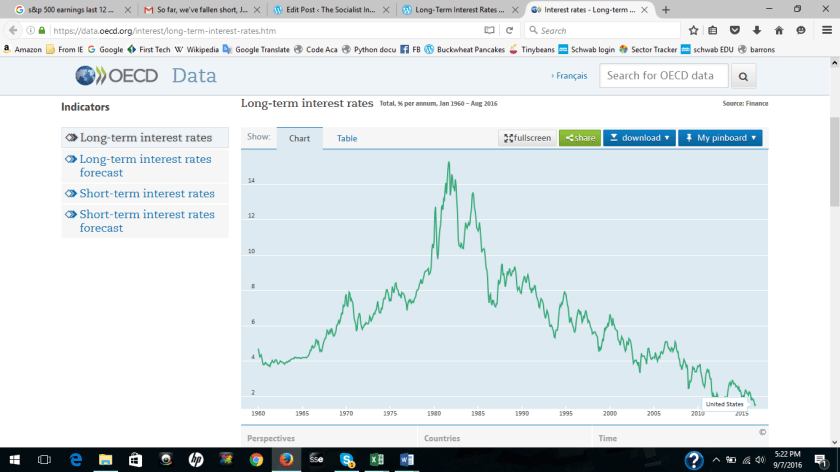
What we see is that sometime around 1987 long-term interest rates became much less volatile and settled into a path of steady decline. Why did this happen? It certainly wasn’t caused by Obama or quantitative easing. Long-term lenders are good at calculating risk, and one risk factor that declined in the late ‘80s was the risk of a major war; another was the risk of inflation, as oil prices fell and investors realized that the Fed could always beat back inflation by temporarily raising interest rates. But why did the decline continue after 1990?
This really looks like deflation in the cost of capital. We know that the expectation of inflation causes long-term rates to rise. What if the expectation of no-inflation had the same effect in reverse?
Another possibility is that, like wheat or rice or paper, capital is now a commodity which we are increasingly efficient at producing and delivering, and that shortages of capital may be mostly in the past. Just to take one example, how much capital was freed up when modern inventory management and supply-chain systems were adopted, starting in Japan in the ‘70s? We used to keep a lot of the world’s capital locked up in musty warehouses for months or years at a time.
If capital is now cheap and abundant, this implies far-reaching cultural and social changes. It might be argued that capital is not so abundant, and the real problem is lack of demand, but surely lack of demand wasn’t a factor in the ‘80s or ‘90s, when this trend began.
Whatever the causes, the decline in long-term interest rates is a settled trend that is only slightly influenced by recessions and booms. The economic growth of the ‘90s did not stop this trend, and the recession of 2001 doesn’t appear to have made it worse. And it’s unclear when and how this decline will end.
Some people on the Federal Reserve would clearly like to reverse this trend. And truth to tell, some well-to-do people in this country would love to see 6% Treasury paper again, whatever the cost to the larger economy. But looking at the graph above, it’s quite possible that we will never see 3% long-term rates again.
Maybe, as with nickel beer and dollar matinees, our economy has simply moved on. But why? What does this all mean? At some point long-term rates should stabilize.
Shouldn’t they?

 The Socialist Investor
No, well-to-do people would NOT like to see higher interest rates! They **LOVE** low interest rates! Low interest rates have fueled the speculative bubble of Silicon Valley venture capitalists and investment bankers. Are you concerned for their well-being?! I’m not, and I am not a socialist. Retail banks do benefit from higher interest rates, but that is not a bad thing necessarily, as I’ll explain.
The people who benefit from normalized, i.e. higher, interest rates (and suffer most from artificially suppressed low interest rates) are individuals with middle class and lower middle class incomes as well as the working poor. They have no way to earn any risk free return on savings with near zero interest rates. Similarly, employee pension and retirement funds (including those for government and union employees) have no low-risk investment choices, which is a very bad thing. Insurance companies are also hurt, as they need low-risk, reasonable return investments for their reserves.
Near zero interest rates benefit the wealthy and hurt everyone else. There is always demand for loans, especially non-commercial mortgages. Don’t worry about that diminishing.
LikeLike
I had a conversation one time with a friend about interest rates. His mother had savings, and she wanted him to find a “fair interest rate” for her that she couldn’t find at her local banks. “How much does she think is fair?” I asked. “8 percent,” he said. This was about 2010 or 2011.
“You used to get that,” he said, perhaps noticing the look on my face.
I get the impression you sympathize with my friend’s mother. Why couldn’t she get 8% on her CDs?
The answer is simple. In a world with lots of accumulated wealth, where we haven’t had a big war in a long time, and with little inflation, you can’t loan money to a bank for much more than the rate of economic growth—2% or 3%. If the Fed is fighting inflation as it is now you can get more, but that’s just a temporary windfall.
You can only get 8% if the bank can loan that money out at 10%. Who would borrow money at 10%? In today’s economy, no one.
Sure, in the ’50s or ’60s you could get 4% or sometimes 5% on a savings account. But (a) the economy was growing faster, and (b) the world was still recovering from WWII and capital was scarce.
The demand for loans is not always there. Raise the mortgage rate to 10% and no one will buy a house.
And I care about the well-being of everyone, because I’m a socialist.
LikeLike
The problem with what you’re describing is that there IS inflation now, quite a bit of it. Also, the rate on mortgages just hit a 20 year high yesterday, of 7.09%. For most of the 10 years up to that time, mortgage rates were around 3%.
Next, the well-being of venture capitalists and investment bankers (a small group of already very wealthy people) is not seriously negatively impacted by the inability to earn large returns on their money with low risk for a few years. The inability for everyone else to receive interest income by saving money in zero risk bank accounts and for retired workers to get the pension money they saved with some sort of return is very important.
At the moment, there is a shortage of homes in the United States. That is due in part to the consortia of private equity investors who bought up most of the housing stock from 2012 to 2018, so that there is a serious undersupply, i.e. only 1,100,000 million homes (new or existing stock) available. Due to inflation, it is more expensive for builders to build, so they aren’t doing as much of that either. Demand for mortgages is impacted by shortage of available housing even more than rising mortgage rates.
Finally, the median home price in the U.S. is now $410,000. This isn’t due to inflation Housing prices steadily increased from 2014 right through the pandemic and on into 2023.
The 1950s were 75 years ago. CD rates were 12% or more during the late 1970s and early 1980s due to inflation and then stagflation, which was broken by Federal Reserve governor Paul Volker who raised rates and slowed down the economy. Interest rates of 8% on risk free deposits sound kind of high to me, however, there’s a BIG difference between getting 4% interest versus 0.001% (the latter has been the rate for CD deposits and savings accounts for the past 10 years).
LikeLike