Socialism — Kuss Ku Say?

“Socialism—doesn’t that mean less fun and more paperwork?” Let’s hope not.

When people talk about socialism, they can mean different things. Historically, socialism was defined in opposition to capitalism, and the idea that the two ideologies might be able to live in harmony, even symbiosis, took a while to emerge. And figuring out the exact aspects of capitalism that needed to be eliminated or modified was (and is) difficult. Some socialists have attempted to eliminate markets, for example, when (in my view) they might better have aimed to guarantee access to markets.

Socialists sometimes talk about eliminating capitalism, without mentioning that they will of course retain aspects of capitalism that seem indispensable—like money,  credit or personal property. Although some versions of socialism may be “revolutionary”  that doesn’t mean they start from scratch.

But how do we define socialism in 2016? Certainly a defining characteristic would be opposition to “billionaire capitalism,” an economic system that is everywhere linked to extreme inequality. Billionaire capitalism captures government as a matter of course, and we see this in Russia, China, the Persian Gulf and (partly) in the US. The alliance between Trump and Putin makes perfect sense—they both believe in a system where the economy and the government are run entirely for the benefit of billionaires. If billionaires occupy the place of honor, then the interests of the masses will necessarily be ignored, and things will go badly for them. Therefore, an essential function of the system is to distract the people from this reality. The people must be fed an endless diet of nationalistic and xenophobic propaganda—things are bad, yes, but it’s the fault of foreigners or minorities. So mass rage and scapegoating is a cornerstone of billionaire capitalism; it’s not a mere byproduct. The hatred directed at Hillary Clinton (and Obama, and Bill Clinton) is not a mysterious remnant of our racist and sexist past—it is part of a modern social and political movement, what I call billionaire capitalism. The hatred will not go away until billionaire capitalism itself is defeated.

If you live in a country where animosity toward immigrants is a noticeable feature of public discourse, then you may be living under billionaire capitalism. Because absent billionaire capitalism, dealing with immigrants is a fairly boring subject (except for the immigrants themselves, of course). No country can absorb an unlimited number of immigrants, but most countries would benefit from some immigration. Of course there are often humanitarian considerations, and cultural issues. But in general, immigration should be a fairly simple matter, not the kind of thing that tears societies in half.

But beyond the opposition to billionaire capitalism, what is our vision for the future? We must have a steady focus on the well-being and unity of our people. Socialism in 2016 is a commitment to science, particularly science that furthers the health and emotional well-being of the population; it’s a commitment to reducing inequality, to increasing individual productivity and wages through investment and education, among other means. It means universal healthcare and public health policies that keep lead out of our drinking water and poisons out of our food. It means strengthening democracy through electoral reform and furthering a sense of community, through education and legal sanctions for hate speech and divisive propaganda. Socialism means aggressive and effective action against climate change and other environmental problems. It means a progressive tax structure.

Socialism implies cultural changes. It’s a commitment to moving away from a culture of violent domination, rooted in slavery and the Indian wars, toward a culture of cooperation between equals. Socialism means a flattening of hierarchies, and making the hierarchies that do persist culturally dependent on a shared sense of responsibility. It means respect between men and women, and steady movement toward an organic relationship between the genders.

It means that children will be cared for, fed and educated and loved. They must get both the freedom and the structure they need to thrive. Children will always listen to adults who are willing to read and play with them, who will tell them stories and sing them songs. Adults who teach children to be violent or fearful will themselves be corrected under socialism—or any humane system.

Socialism will care for the mentally ill, and not leave them to self-medicate under bridges, sleeping outside in all weather. I don’t define social problems as “moral issues” very often—I don’t think it’s useful—but the treatment of mental illness in our society is inexcusable. And this is true of other public health issues as well. Much of our population suffers from diseases that seem to have no clear origin, or which have achieved a scale that defies explanation—for example the opioid epidemic. Why are so many of our people, particularly in rural areas, dying before their time? What a world of suffering there is in modern America. We need a collective effort, on the order of the Apollo program, to understand and treat these illnesses.

And our people, young and old, need adventure. They need to dance more and watch TV less. They need to hike deep into the wilderness and watch foxes play beside a lonely river. They need to have a sense of movement and light, of art and music. Young and old, they need to play sports more and watch sports less. They need to sing together and share their hopes with friends late into the night. They need to walk and speak as if the world were still young.

Socialism is a vivid awareness that we’re all in this together.

Trump and Oxytocin

Early this morning Donald Trump was elected president.  Most immediately, this is test of our oxytocin levels, of our ability to keep love and empathy alive.

We cannot put conditions on life. We cannot coach or nag it into giving us what we want. The morning of the election I was filled with triumphant joy, a feeling that I knew (in some deep place) might be false.

If people were unable to feel joy and love under bad rulers, if they were unable to find spiritual shelter in political storms, the human race would have died out long ago. And yet here we stand, uncertain in the changing light.

We can never know the full consequences of any event. Some good may come out of Trump’s election. In fact this may prove to be the breaking point we need; perhaps we have finally hit bottom. Or perhaps Trump will govern from the center to some extent, as improbable as that sounds.

As I adjusted the stop-loss orders on my securities in the small hours of the morning, I reflected that it is quite strange to continue to try to make money (or to lose money slowly), in this situation. But anyone with a job must generally show up for work the day after a terrible disaster. Only for the deaths of family members does capitalism grudgingly make an exception to this rule.

If the markets will be open, then I must be ready, if only to sell everything. But in general I do not sell. I tighten some stop-loss orders, and sell one security to protect a profit. I hear owls hooting outside in the trees. We may lose all the progress Obama made on climate change, we will probably lose Obamacare and maybe Social Security and Medicare as well. I wonder how I am to get healthcare without Medicare. Perhaps I could go to Ecuador.

But I let the Ecuador idea drift away; after all, this is the country where my grandparents are buried. Tomorrow is another day, and I must take whatever opportunities the market—and the universe—offer.

And tomorrow we have one more day to show our love, and to present our natural dignity and grace to the world.


Airline Stocks are Taking Off!

In late 2015, I began work on my stock investment strategy for 2016.  I took a sector and industry approach—which sectors and industries were likely to do well as the US economy improved, as seemed likely? Among other conclusions, I decided that airlines might be a hot industry in 2016.

My reasoning was that as the US economy continued to recover, and employment rose, that people were going to have more discretionary income and possibly take more trips. And when I looked at airline stocks, some of them had sound financial statements and had increased sales and earnings in both 2015 and 2014. Some of the best were regional players, such Alaskan Airlines and JetBlue. Also Southwest Airlines which—although no longer a regional airline—retains the culture and habits of a smaller airline.

I was also looking at fuel prices, which are a major cost for airlines. I did not see oil prices going up in 2016. With the economy recovering and fuel prices at an extreme low, how could airline stocks not rise?

I made a vast spreadsheet and memorized the definitions of airline metrics, such as ASM, PRASM and CASM. (“Average Seat Mile”—a measure of capacity; “Passenger Revenue per Average Seat Mile”—a measure of revenue versus capacity; “Cost per Average Seat Mile”—a measure of cost divided by capacity.) I was an eager student.

Then I made my investments, which I structured as trades even though I imagined these stocks rising steadily throughout the year. In a trade, if the stock declines by so much, you sell it—and if it increases by so much, you sell it. A trade is a temporary investment.

All my trades exited on the low side; Alaskan and JetBlue struck out repeatedly. I didn’t buy Southwest; I thought I’d start with the smaller airlines, which had shown more growth recently than Southwest, and then later buy Southwest. But I lost money on every move I made. On the first couple of trades, I was so convinced that they were winners that when they fell to the exit point (that I’d previously decided on), I kept them until they fell significantly further. I was stubborn about airlines. Okay, maybe they’re not going up now, but one more day!

In investing, this is like the moment in backpacking when you’re lost and you think, “this compass is broken!” Because the worst part of being lost is not knowing it, and the worst part of not knowing it is violently denying it.

And I was influenced by the concerns, frequently expressed in the financial press, about the stock market being “over-valued,” which means that company earnings are too low to justify the stock price. There’s a metric, “price to earnings ratio,” (P/E), that captures this relationship. A good P/E varies from industry to industry, but in this day and age any P/E under 20 is at least decent, and plenty of good stocks have a P/E over 20.

My airline stocks all had good P/E. Alaskan Airlines had (at that time, in December 2015) a P/E of 13.05, quite presentable, with a forecast P/E of 12.5, over the next 12 months. JetBlue had a P/E of 13.52 with a forecast P/E of 11.8. And the prediction for JetBlue’s growth was phenomenal. Its PEG (P/E divided by its growth rate) was .25, an amazing figure, especially when you realize that “any PEG under 1.0 is good” as one source put it.

And I had other metrics, lots of them: sales growth, return on equity, net profit, return on assets, debt-to-equity ratio, plus the “ASMs,” the airline-specific metrics. And JetBlue looked outstanding on all the metrics. And it had a good culture and seemed poised for growth.

Here is what happened to JetBlue’s stock price in 2016:

image002

As of September 22, the stock is down 21% for the year. What happened? It’s hard to say, but fear of terrorism is sometimes noted in the press. Flights are mostly full, but the airlines haven’t been as aggressive at raising fares as they might have been. (Do they sense a softness in demand?)

Fuel prices remain a bargain. And if the airlines are under wage pressure, I haven’t heard about it.

From my point of view, the stock didn’t go up because it didn’t go up. I don’t see any convincing explanations.

It’s certainly not due to financial mismanagement either. JetBlue’s current P/E is 7.64. No, that’s not a typo. JetBlue’s P/E has fallen by nearly half in 10 months, and the market has rewarded that with a 21% decline in its stock price. According to the tenets of fundamental analysis, people should be rushing out into the streets to buy this stock. Mobs of investors should be forming on street corners.

And Alaskan Airlines, my second favorite airline last year? Its stock declined by 16%, while its P/E improved to 9.24.

The financial press seems to have a guideline—that about 10%-15% of all articles assert, with breathtaking confidence, that the stock market will go up only when the average P/E reaches 15 or 12, or some other number that was popular in Grandpa’s day. And if the market goes up anyway, then this will all end in tears.

But my message is different. Anytime you think you have a sure thing, consider your methodology. Fundamental analysis is so rigorous and quantitative that it seems almost infallible. But the economy is not a closed system. Anything can affect the economy, and the markets that reflect it—and that “anything” may or may not be visible to fundamental analysis, because no methodology includes everything.

Anything, anything, anything.


Civilization and Change

In Civilization and Capitalism, Fernand Braudel points out that civilizations are generally deeply conservative. In food, clothing, social structure and religion—even interior decorating–they change slowly. Bread was eaten in ancient Egypt just as it is in modern Spain, and the consumption of rice in Asia is of similar antiquity.

This stability is reinforced by culture, even by religion. Of course people in the West eat potatoes and rice, rye and oats. But wheat bread is still the “staff of life,” just as it was in the time of Christ, and it figures in Communion, the central ritual of Christianity.

It took over two hundred years for corn to be widely accepted in the Old World, and even longer for the potato, a change that might have taken a generation or two according to strictly rational considerations.

And likewise with dress: people in parts of the Middle East still dress as Moses dressed, and dress in China seems not to have changed until Sun Yat-sen’s reforms in 1912.

And in ideology there is a similar conservatism. China did not change its model of social relationships and of governance from Confucius’ time to the fall of the Manchu dynasty. Neither Buddhism nor the Mongols nor the Manchus changed anything basic. The population endured periodic invasions, anarchy, famine and depopulation—-only to repeatedly restore exactly the same form of government once peace made it possible.

In India caste distinctions are often still important, despite the opposition of venerated leaders from the Buddha to Gandhi.  And in Islam the opposition to calendar reform and usury endure.

Everywhere people cling to decisions and habits formed centuries or millennia ago. They don’t cling to everything, of course, but they cling to enough to prove Braudel’s point.


However, there is one exception—Western civilization. In some contexts the West shows a voracious appetite for change. And indeed we have integrated change into our institutions and values—-the concept of “progress” has given the West its unique dynamism, and lies right at the heart of both Marxism and capitalism. Along with science, progress is the Western concept that has affected the non-Western world most profoundly.

So that’s nice, isn’t it? We are the civilization that embraced change, and in return we got untold power and wealth, and modernized the world. Almost beautiful, isn’t it? Until you remember *why* other civilizations have generally rejected change, or only accepted it when it was closely directed by sacred forces—as in the Book of Revelation.

Very simply, people reject change because (a) it’s dangerous and alienating, and only produces good at a cost, and (b) they over-estimate their ability to prevent change.

If you look at the changes in the West in the last century—we see World Wars I and II, the fall of European monarchies, the rise of fascism and communism, the rise of America, the Cold War, the development of post-Marxist plutocratic regimes in both Russia and China (and something similar here), the introduction of Buddhism to the West, the invention of nuclear weapons, computers, antibiotics and mass propaganda and a general disillusion with Christianity—except where it has linked itself to nationalism. People no longer read poetry or ancient mythology and they no longer sing with their friends—for the most part. Over the past century, people in the West have become significantly more isolated and less grounded in their communities and families.

That’s a lot of change, and we have to ask ourselves, is change spiraling out of control? And has it been worth it so far this century?

Most human societies have regarded change as an enemy, and there’s some justice to that.  Once the state has established a degree of peace and continuity, then the farmers can usually make a crop without being attacked by soldiers or bandits, and that gives the entire society relative food security. The general feeling has been that if we’ve got enough to eat then we can deal with our other problems on a case-by-case basis. Forget the local sultan and his nutty ideas—are the farmers able to plant without being robbed or murdered?

(And the need for social stability to ensure the food supply is especially strong where agriculture depends on complex irrigation systems, as in ancient Mesopotamia and China. A minor revolt or invasion upstream can result in mass starvation.)

And this is not just a matter of food security. Having a common ideology or religion certainly limits conflict within a society or civilization. When the Norwegians under Olaf II debated the adoption of Christianity, one practical merchant pointed out that if the Norwegians became Christians they were less likely to be murdered and robbed on trading voyages to Christian countries. That apparently cut through all the discussion about Odin and Jesus and the merchant carried his point. If even Vikings appreciate the safety of a common ideology….

But when confronted by change, the West has often seen opportunity and not potential disaster. It has said: Let ‘er rip. Things are going to change anyway, so let’s ride that wave. From the spice craze of medieval times to smartphones, we have gone after change before it could come after us.  And there’s a crazy realism there that obviously produces results.

But choosing the path of change doesn’t free us from the risks that other civilizations have rightly pointed out. Instead, it intensifies those risks and possibly makes them non-linear. The West’s strategy has been successful—if you don’t look too closely—but glorying in our success we now deny that there were ever any risks! But there were, and there still are.

And living in a society that mostly discounts the cost of change is stressful and alienating, because it’s a denial of reality. Our inability to govern change almost destroyed our civilization during the twentieth century. We lived in continuous danger from 1914 until the end of the Cold War, and the respite we got from the fall of communism was welcome, but only temporary.

As I write this, in September 2016, there is a chance Donald Trump will be the next president. In a civilization that can reasonably channel the forces of change, my last sentence could never have been written.

And if the West, which has ridden change from success to success for six centuries, can no longer produce success through change, then what? What is the basis of our civilization?


The Logging Road

The loggers cut a new road through the woods, a half mile or more, to thin a few acres. The road went straight down a steep slope. It only occasionally turned sideways onto a contour in order to find another steep run downhill. The soil is surprisingly loose on this forested slope. The first big storm will turn this road into a vast gully.

I am used to slopes that are all rock and clay. The quality of this New Jersey soil is extraordinary. How is it that people have told me all sorts of nonsense in my life, but no one ever mentioned the gorgeous soil of western New Jersey?

I walked up there today with some tools to build water bars. Weak from a recent illness, I was sweating profusely after 20 minutes of walking uphill. I had to slow down. Slowing down, slowing down. I hadn’t even started on the work itself, and I was already exhausted.

I had an ax I had sharpened the night before. It was almost sharp enough to shave with, and I had to keep it carefully covered as I walked, to avoid a bad cut.

I had a shovel, also recently sharpened. Am I the last man on earth who realizes that shovels need to be sharpened?

I took landscaping staples, for holding fabric in place on the ground. I had a small sledge for driving them in, and a pair of leather work gloves. I also brought old sheets and pillowcases, and a pocket knife.

The logging road started at a paved road uphill.  The day before I had left four hay bales up there, as well as a rake and grass seed. Also I dropped off a big roll of fabric designed to allow grass seed to incubate; spread out and anchored, this made excellent anti-erosion material, catching bits of leaves and bark.

First, I made a water bar out of some of this fabric, rocks and hay, right at the top of the logging road. You don’t have to dig to make a water bar, you can make it out of anything.  I worked slowly, trying to recover from the walk uphill. I tied scraps of old sheets around the rocks and knotted them up tightly. Then I stretched out the loose ends perpendicular to the direction of runoff and staked them down using the landscaping pins. I wrapped the seed germination fabric around clumps of hay and then put big rocks on top. The fabric stretched from one side of the road to the other. I laid it out at a slant, so some of the water might run off the road on the downhill side.

Standing up to fetch more rocks, and then carrying them back—that was the part that forced the sweat from my skin.  My knees and back were uneasy with my plan to repair these few acres of forest.

After I finished the water bar, I began working my way downhill. With the hay and grass seed and tools, I had to make multiple trips. I spread sections of hay bales fifty feet or so apart down the mountainside, so I’d have hay available wherever I was working, and I did the same with an extra bag of grass seed. I put the tools down where I planned to make the next water bar, and then I walked back up to the first water bar with a bag of grass seed. It was getting hotter.

I began to sow grass seed broadcast when I noticed a new problem. There was an old logging road from years before that intersected the new one; the old road was uphill.  It was covered with brush and grass and small trees—several years of re-growth.  But there was a new gully on the old logging road just above the new road; the two or three evening rainfalls had ripped away the soil and vegetation. Shocked, I realized the new road had changed the velocity of water flow upstream, on the old road. If water flows faster downstream—because a logging road has been cut straight downhill—then it will also flow faster upstream as well. A bad road can actually cause erosion in areas the bulldozers didn’t touch.

I patched the new gully with hay, big stones and broken branches. I threw a lot of material and energy into that work, because I could see the potential for runaway erosion, with one section of the mountainside setting off erosion on nearby sections, and so on. And more immediately, if the gully grew it could wash away much of the grass seed I’d planted on the road.

It was all difficult, and I had to be mindful of my every move. I made my way slowly downhill, where the logging crew had made its single anti-erosion effort. At one bend they had used a bulldozer to make a low earthen dam maybe ten inches high. It wasn’t slanted and there was no ditch for runoff into the forest; the water would just pool up in front of the dam and eventually breach it. But I could work with this dam; I dug a ditch in front of it that I tapered off into the woods, so now there was drainage. And I covered the dam itself with scraps of cloth and rocks.

And then, because uphill is usually better in this work, I built a proper water bar about thirty feet uphill, with fallen branches, hay, and rocks. I had rocks in front of the branches to slow the water, and behind them to keep them from being swept downhill. Hay was underneath every rock and stuffed into every gap.

With this, any water that reached the dam would be moving slowly.

I broadcast grass seed between the water bar and the little dam, and then moved everything I had further downhill. Here there had been serious tree thinning, and there were small logs and large branches scattered around. I chopped some stakes from a long branch and built another water bar out of logs, staked into place. It was a steep section, so I also used rocks to reinforce the log on the downhill side. I stuffed pieces of cloth into all the little chinks. Uphill there were already small gullies forming, so I put hay and rocks in all those.

I built another water bar further downhill, also using logs and some of the seed germination fabric. I was getting low on hay, so I walked up to the first water bar, near the paved road, and tore open another hay bale. It feel apart into neat sections and I tucked two sections under each arm and walked back downhill.

I was getting tired again. For all my intense thought about the flow of water, I had forgotten to bring water to drink. “The shoemaker’s children run barefoot,” as my mother would say.

It had gotten cloudy and it wasn’t quite as hot, but it was as still as death. The foliage was so thick, it was like an extra layer of clothing. A sudden movement went through the leaves of the forest, and I couldn’t tell if it was raining or just a sudden burst of wind. It passed without any rain reaching my head.

I scattered more grass seed on the road above and below the last two water bars. Then I prepared to leave, putting rocks on top of the half-empty bag of grass seed, hoping to prevent—or delay—rodents from a feast. I stacked the remaining hay next to the grass seed. I had already abandoned the rake up by the earthen dam; I had too much to carry. I took the other tools and the seed germination fabric and started walking downhill, where I knew there was a path to the house. But on the way I found a particularly bad gully in a spot where the road slanted into a small ridge that ran parallel with the slope. All the runoff was funneled into this area. I had no more hay, but I did have the remaining fabric, still rolled up. I put the entire roll lengthwise in the gully and put a couple of logs on top of it. I felt like a retreating soldier abandoning his weapon.

Before I left I realized that the low “ridge” was the ruin of an old stone wall, half buried in soil and dead leaves and covered with vines and brush.

How long ago was this stone wall new? Did the men who built it love and fear and grieve as I do?

The road needed two or three more water bars, work for another day, so I might have left the tools if I could have sheltered them from the rain. The rake was already weathered beyond concern, so I felt okay about leaving it outside for a day or two. But as it was I had to carry the ax, the shovel and the sledge home with me, where I had to leave my muddy boots outside. Unlacing them took a long time. Once inside, I sat and drank iced water for half an hour before I got the energy needed to undress and shower. All my clothes were soaked with sweat.


Missing the Scale

A few days ago I worked on an eroded stretch of gravel farm road (not the logging road discussed above). I put old hay in all the little gullies and weighed the hay down with rocks. I did a careful job of tracing the flow of water and placing little barriers to slow it. It’s especially important in this work to get the upstream parts right.

That evening it rained heavily for about half an hour. I inspected my work the next day. I did not expect to see much difference, because this was not a big winter storm but just a summer evening rainfall.

But I was mistaken. Although my system held up fairly well, in some places the force of the water had carved new channels and in a couple of spots the hay had been pulled out from under the rocks completely.  Other places the stones and hay stood fast, and were half-buried in twigs, bark and silt. It was as if the barrier had gathered its treasures about it during the storm.

In 2016, scale is tricky. I saw the outline of the problem, but I missed the scale by at least a factor of two. My anti-erosion efforts would not stand up to a big winter storm.

The cynicism and delusions of modern America are on a scale that we missed.

Guided by my natural experiment, I spent much of the morning strengthening and expanding the hay and rock barriers. When water flows across the earth, it is either cutting soil away or depositing it, depending on its velocity. There is no steady state.

Long-Term Interest Rates

The markets have recently been hypnotized by the Federal Reserve, and whether it plans to raise interest rates soon. The last time the Fed raised rates, in December 2015, it was not a nice experience for investors. The economy wasn’t ready for it and the markets weren’t, either.

Janet Yellen gave a measured speech on Friday, August 27, and said mostly obvious stuff in a soothing way. Shortly afterward, the vice-chair, Stanley Fischer, told CNBC that Yellen’s remarks were “consistent with two rate increases this year.” No one had considered the possibility of that, and markets temporarily backed off.

Certainly the Fed stands accused of sending mixed messages, and it almost looked as if Fischer was trying to manipulate the markets by suggesting something that had previously seemed outside the realm of possibility. Central bankers are not supposed to surprise the economies they oversee.

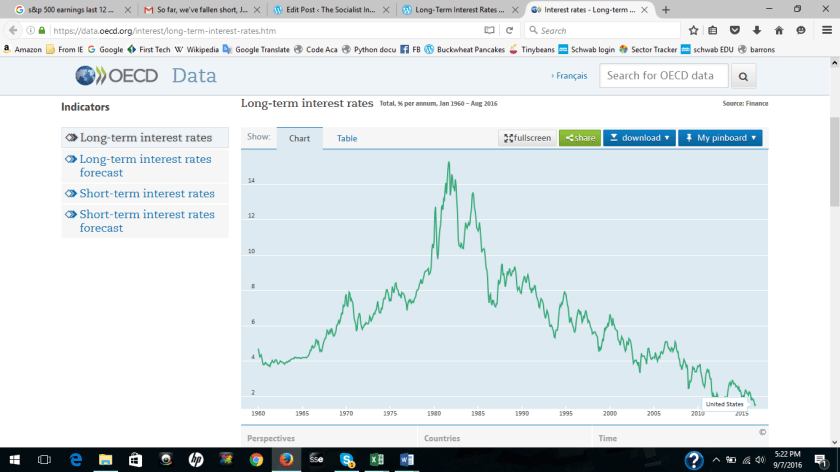
But with inflation under 2% and second-quarter GDP growth year-over-year at 1.1%, why raise rates at all?  Really, there seems to be no good reason. But if not why, then perhaps we can ask who? Who wants interest rate increases? Well, the banks of course, because they believe they can make money on higher short-term interest rates, and they do make money on existing variable-rate loans. But higher rates may suppress the demand for new loans, and “demand” is the key word here. There doesn’t seem to be a lot of demand for loans in the US or the world right now, at least not enough to keep long-term rates from falling. Here’s what’s happened to long-term interest rates in the US so far over the last year (source: https://data.oecd.org/interest/long-term-interest-rates.htm).

image001

I am not a trained economist, but this graph is consistent with weak demand for long-term loans. Bear in mind that this period was one of economic growth and falling unemployment.

So, it’s questionable whether the banks would make much money off higher rates, because the demand for loans is not currently strong and might well decline in the face of higher rates. But even if the banks make money off higher rates, why should the rest of us care? The economy seems to work just fine without the banking industry making strong profits. Of course banks and bankers have a lot of influence, and the Fed may want to please them, but would they risk throwing the US into a recession in order to give the banks a chance—merely a chance—of making significantly higher profits? I doubt the Fed is that irresponsible.

But there’s another wider who—everyone in this country with significant net worth. If you have a net worth of $5,000,000—let’s say—and have a taste for golfing and sailing and shopping for furniture and antiques, then twenty years ago you could invest everything in 6% Treasury paper and have had $300,000 per year to spend at your leisure. You wouldn’t need to spend more than 30 minutes a year thinking about how to make money. Nowadays you can get 1.57% or $78,500, which precludes sailing or a golf club membership, although maybe you could play a few rounds a year on a public golf course, if any are near you. At $78,500, you might actually need a job.

The difference between 6% and 1.57% is the difference between quiet luxury and the limitations of middle-class life. And that’s felt as an actual injustice by some well-to-do people.  They look at recent history and they see ever-lower interest rates and they listen to commentators who blame this on quantitative easing, both I and II, and they know in their bones that this isn’t right, that they’re being robbed by malevolent political and social forces.

However…..let’s look at another graph, of long-term interest rates since 1960:

image001

What we see is that sometime around 1987 long-term interest rates became much less volatile and settled into a path of steady decline. Why did this happen? It certainly wasn’t caused by Obama or quantitative easing. Long-term lenders are good at calculating risk, and one risk factor that declined in the late ‘80s was the risk of a major war; another was the risk of inflation, as oil prices fell and investors realized that the Fed could always beat back inflation by temporarily raising interest rates.  But why did the decline continue after 1990?

This really looks like deflation in the cost of capital. We know that the expectation of inflation causes long-term rates to rise. What if the expectation of no-inflation had the same effect in reverse?

Another possibility is that, like wheat or rice or paper, capital is now a commodity which we are increasingly efficient at producing and delivering, and that shortages of capital may be mostly in the past. Just to take one example, how much capital was freed up when modern inventory management and supply-chain systems were adopted, starting in Japan in the ‘70s? We used to keep a lot of the world’s capital locked up in musty warehouses for months or years at a time.

If capital is now cheap and abundant, this implies far-reaching cultural and social changes. It might be argued that capital is not so abundant, and the real problem is lack of demand, but surely lack of demand wasn’t a factor in the ‘80s or ‘90s, when this trend began.

Whatever the causes, the decline in long-term interest rates is a settled trend that is only slightly influenced by recessions and booms. The economic growth of the ‘90s did not stop this trend, and the recession of 2001 doesn’t appear to have made it worse. And it’s unclear when and how this decline will end.

Some people on the Federal Reserve would clearly like to reverse this trend. And truth to tell, some well-to-do people in this country would love to see 6% Treasury paper again, whatever the cost to the larger economy. But looking at the graph above, it’s quite possible that we will never see 3% long-term rates again.

Maybe, as with nickel beer and dollar matinees, our economy has simply moved on. But why? What does this all mean? At some point long-term rates should stabilize.

Shouldn’t they?

In the Darkness

Cows are dumb, or at least that’s what people tell me.

However, at this moment, nearly midnight on a hot summer night, I am having doubts. Three of our cows have escaped captivity, despite our conviction that the fences would hold them. They are new cows, not settled in. We chased them all day through dense forest and cornfields, in temperatures approaching 100 F with East Coast humidity. Weather that at this latitude—almost halfway between the equator and the North Pole—is probably influenced by climate change.

And this, during an election year with Donald Trump as the popular choice of the Republican Party, one of the most powerful political institutions in our civilization. So Trump has a chance to be President, the climate is menacing, and three of our cows are probably somewhere in a neighbor’s cornfield. And I’ve been tramping through a Lyme disease hot spot all day with a machete and a bucket of cow feed.

But tonight the three cows returned. They didn’t return to the pasture, but close, just outside the fence. So I am trying to coax them down a narrow road to the gate, using “cow candy”—feed laced with molasses. I tasted it and it was hardly sweet at all, but to cows it’s like a Halloween bag full of Butterfingers. So I am giving them a bit of cow candy, walking toward the gate for a few paces, then turning around and giving them a bit more. This works up to a point, but then the cows stop and slowly retreat uphill, away from the gate. They clearly want the candy, but something is bothering them. I go after them and feed them a bit more to retain their interest, and then start backing up toward the gate again.

We go through this three or four times, and finally I realize that it’s the darkness. It’s a moonlit night, a little hazy, and visibility is good in most of the pasture. But the gate area is shaded by big oaks and walnuts, and the fence adjoining the gate is also shaded. The cows follow me until they see they have to walk through relative darkness, and then they back off. Obviously a predator could be lurking. It doesn’t seem that dark to me, but I’m not worried about a hyena attack. Their night vision might be worse than ours, or there might be some other reason I haven’t thought of. I prefer the predator theory, but I can’t say for sure why the cows are behaving this way.

But whatever the reason, there’s no doubt it’s easier to lead people into darkness than it is cattle.

I suppose people are bound to fear predators less than cattle do; large land predators have mostly left us alone for the past 8,000 years. But what has replaced predation as a threat to our survival? Besides bacteria and viruses, it’s the lies we tell ourselves and each other, and anything else that clouds the mind.

And the more organized and socialized the lies are—like wolves and lions—the more dangerous they are. The cattle may believe that lions are waiting in silence for them to approach the gate, but what about me? What’s waiting for me? I could say: nationalism, narcissism, the loss of science.

But really it’s a coldness in our minds that looks at reality and decides to lie about it. That simple moment when Peter denies Christ and we deny the light of truth.

That’s what is waiting for me, in the woods beside the cattle gate. It’s consumed so many men and women, and it seems impossible that I might escape. But perhaps I can, perhaps I can.


We managed to get the cattle back in the pasture; we waited for hours until the moon was lower and the path and gate were clearly lit. Then, staggering with fatigue, we got the cattle back in the pasture using the cow candy. We only slept a few hours but we woke up with a splendid sense of well-being.


A State of Mind

I invest because it’s inevitable that anyone with capital must invest. I am a socialist because I feel a kinship and sympathy with other human beings, and I do not want my economic life to alienate me from others.

This blog is partly about cultivating a state of mind which I hesitate to name for fear of reducing to it to dust. Let’s say it’s something like a humane clarity, although it must also encompass and reflect experiences that are neither humane nor clear.

The specifics of investing and of socialism, among other subjects, will get their turn. However, this blog will not be about socially conscious investing, which I do not recommend. Socially conscious investing (or sustainable investing) is an effort to do two complicated things at once: change society for the better, and make money investing. One of the advantages of investing as a mental discipline is the frequency with which opinions and preconceptions are destroyed by markets. But socially conscious investors never have to confront that experience, because their poor returns are never clearly due to mistakes—they may just as easily be the price of social progress.

We cannot cultivate a humane clarity if we never have to face and correct our own confusion.